
Hating Heathcliff Is Easy
sitting with what the novel has to say about human psychology can be wuthering...


People who study literature aren’t typically called into crisis situations. But when Emerald Fennell’s “Wuthering Heights” hit theaters in February, the internet had questions, and the English majors were READY TO GO.

One of the most hotly debated aspects of the new adaptation (besides casting) was Fennell’s decision to brand the film as a love story and soften Heathcliff into a more sympathetic leading man. Readers of Emily Brontë’s source material were quick to point out that Book Heathcliff is much rougher around the edges than his Jacob Elordi counterpart.
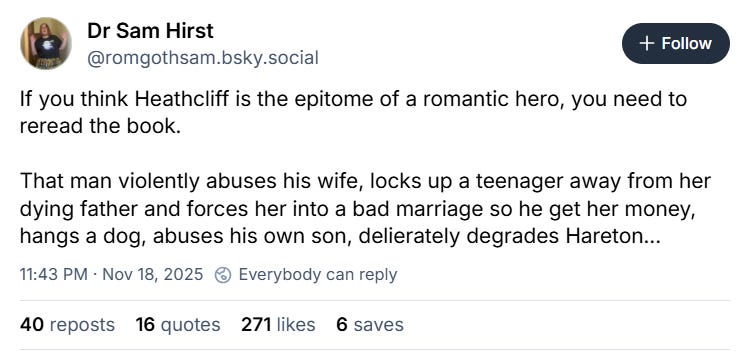
As part of a McSweeney’s humor series about red flags in classic literature, I, too, targeted Heathcliff by listing every terrible thing he was guilty of (along with a faux justification for it).
But as easy as it is to jump on the “Heathcliff is a villain” train, it’s worth pointing out that he is far from alone in his behavior. Hindley drowns a whole litter of puppies and tries to trample Heathcliff underneath a horse. Joseph spews misogyny and encourages fasting and flogging as punishment. Cathy shakes Hareton (an infant at the time) until he goes limp. Then she slaps Edgar for trying to leave the room.
And for all their wealth, the residents of Thrushcross Grange are no better. When we first meet Edgar and Isabella, they are arguing over a puppy, each pulling at one side of it and threatening to tear it in two. Later, Isabella violently claws at Catherine’s arms, and Edgar punches Heathcliff in the throat.1 And even Mr. Lockwood, a “civilized” visitor to the moors, doesn’t hesitate to pull an unknown arm back and forth across a broken window pane.
Thus, the near constant violence of Wuthering Heights cannot be blamed on a single bad dude. Nor can it be explained solely by environment and trauma. Instead, violence and cruelty appear to always be within reach—even for the novel’s meekest characters.
To some readers, this is an indictment of the story itself—a terrible book about terrible people. But others (me!) find an honesty there that resonates. Unlike the preachy heroines of her sister Charlotte, Emily’s characters seem to embody an authenticity about what it means to be human—to have the capacity for both great love and great cruelty, and to struggle while navigating the rugged terrain of that range.
If we return for a moment to Lockwood sawing a stranger’s arm across a broken window pane,2 we find the following explanation for the behavior: “terror made me cruel.” If this line doesn’t strike a deep chord within your self awareness, you should probably read it again. (And if it still does nothing for you, you should probably work on your self awareness.)
In my opinion, the truly haunting element of Wuthering Heights is not the gravedigging or ghosts but the disturbingly accurate understanding of human psychology it offers. Almost a century later, Sartre would echo some of these insights, noting that humans experience “capital A” Anguish when they realize they have the freedom to do anything (both wonderful and terrible) at any given moment.
When we reduce Wuthering Heights to a terrible book about terrible people, we protect ourselves from having to think about some of the more messy and staggering aspects of human nature.
When we see Heathcliff as nothing more than a walking bag of red flags (and Cathy as nothing more than a drama queen), their relationship becomes “toxic”—a selfish obsession that destroys them and everyone around them.
But is it really that simple? Catherine and Heathcliff are difficult people, for sure—wild little forces of nature—but Brontë’s sympathies seem to lie on their side, and it is their separation rather than their togetherness that wrecks havoc.
If anything, the generic “love story” frame doesn’t seem to go far enough in capturing the type of connection Brontë implies3 —an all-consuming, transcendent, supernatural kind of union: “I am Heathcliff,” Cathy claims. “He is more myself than I. Whatever our souls are made of, his and mine are the same.”
In opposition to 30 Rock’s Liz and Carol (who are too similar to be together), Cathy and Heathcliff are too similar to NOT be together, and whenever something is standing in between them, they quickly descend into cruelty.

Regardless of whether or not this type of connection is actually possible, its realness to the characters ultimately results in real consequences. In both the novel (and Fennell’s adaptation), the story’s housekeeper/narrator Nelly goes ALL IN on calling Catherine’s bluff—surely she will drop the act when the people around her stop entertaining her emotions, right? But it backfires. CATHY DIES. And Nelly becomes the cruel one for failing to understand the gravity of the situation—or worse—for intentionally turning a blind eye to it.
I think about this all the time when I encounter people (myself included) experiencing big feelings: How do I determine the authenticity of another person’s psychological state? How do I protect myself from being taken advantage of? When will pushing someone force them to rise to the occasion, and when will it push them over the edge?
It has been frequently noted by biographers that Emily Brontë had a close relationship with her brother Branwell, whose substance abuse often led to self-destructive behavior. In reading Wuthering Heights, one can easily imagine Bronte processing some of this real life trauma on the page, and asking, as Ellen O’Connell Whittet so succinctly puts it, “What does it mean to love someone who is suffering and who is, by any conventional moral measure, making themselves unlovable?”
I don’t have an easy answer to questions like these, and I don’t think Brontë does either, but these are the kinds of things Wuthering Heights allows me to grapple with when I allow it to be more than just a terrible book about terrible people.
Note: Heathcliff does not return Edgar’s blow, preferring instead to deliver this zinger: “By God. Mr. Linton. I am mortally sorry that you are not worth knocking down.” Over the course of the book, Heathcliff actually takes more punches than he throws.
I’m sorry, but if you’re going to do a Wuthering Heights adaptation, you need to at least give a nod to this scene.
Watch me abandon in real time everything I learned in Literary Criticism 101 by claiming that authorial intent is something we can know.